A container is sitting at the port. It has been there for four days. Your production line needs the cashew kernels inside it by Friday, and nobody at the terminal can tell you exactly why the shipment was flagged — only that “documentation is under review.” This is the moment most procurement managers first search for this article. It rarely happens on the easy shipments. It happens on the ones where a spec sheet looked fine on paper.
This guide is for procurement, supply chain, and import managers at UK and EU food manufacturers who buy raw agro-commodities from Africa — cashew nuts, soyabeans, sesame seeds, cocoa, ginger, shea butter, hibiscus flower, and charcoal — and who need shipments to clear customs without delay, demurrage, or a stalled production schedule.
At BV Integrated, we run what we call the Zero-Rejection Protocol™ — six checkpoints (Sourcing, Grading, Testing, Packaging, Documentation, Delivery) that we apply to every export shipment before it leaves origin. This article sets out what that protocol checks for, why most shipment holds trace back to a gap that formed weeks before loading, and exactly what a compliant shipment file looks like — so you can hold any supplier, including us, to the same standard.
Why Do African Commodity Shipments Get Held at UK & EU Customs?
Direct answer: Shipments are most often held because of a mismatch between what the paperwork claims and what testing confirms — not because the commodity itself is unsafe. Common triggers include aflatoxin or moisture levels above EU/UK maximum limits, missing or incorrectly issued Phytosanitary Certificates, and Certificates of Origin that don’t match the shipping documents.
Under EU Regulation (EU) 2023/915, raw tree nuts intended for direct human consumption carry a maximum total aflatoxin limit of 4 µg/kg (with a stricter 2 µg/kg limit for aflatoxin B1 specifically), while nuts declared as “subject to further sorting or processing” are permitted higher limits but must be labelled accordingly. A cashew shipment tested above these thresholds, or one missing the required processing label, gets flagged before a customs officer even opens the documentation. In Great Britain, high-risk food and feed of non-animal origin, a category that includes several African commodities can only enter through a designated Border Control Post, where documentary checks are mandatory and physical or laboratory checks may follow, per Food Standards Agency guidance.
Most holds are not dramatic contamination cases. They are administrative: a Certificate of Origin issued by a chamber of commerce that doesn’t match the invoice’s HS code, a Phytosanitary Certificate dated after the vessel sailed, or a lab report referencing a different batch number than the one on the bill of lading. Customs and port health authorities are trained to catch exactly this kind of drift between documents, because it’s the most common early signal of a bigger compliance problem.
What Actually Happens Before a Shipment Is Flagged
A compliance gap almost never starts at the port. It starts weeks earlier, usually at the point of sourcing or grading, and stays invisible until someone finally tests the batch that’s about to travel.
Here’s the operational reality most buyers don’t see. A supplier sources cashew or sesame from multiple smallholder farms or aggregators across a harvest season. Moisture content, foreign matter percentage, and aflatoxin exposure vary batch to batch depending on drying conditions, storage time, and handling — even within the same farming region. A spec sheet sent to a buyer in January often describes the target specification the supplier intends to deliver, not a verified result from the specific consignment that ships in March. Between those two dates, a lot can change in a warehouse.
This is the gap between what a buyer sees and what’s actually tested. A spec sheet says “moisture: max 10%.” That’s an intention. What determines whether the shipment clears customs is the moisture reading from an independent lab test on the actual export lot — ideally drawn using a proper sampling protocol (multiple increments across the container, not a single scoop from the top layer), tested close to the loading date, and referenced by batch number on every subsequent document.
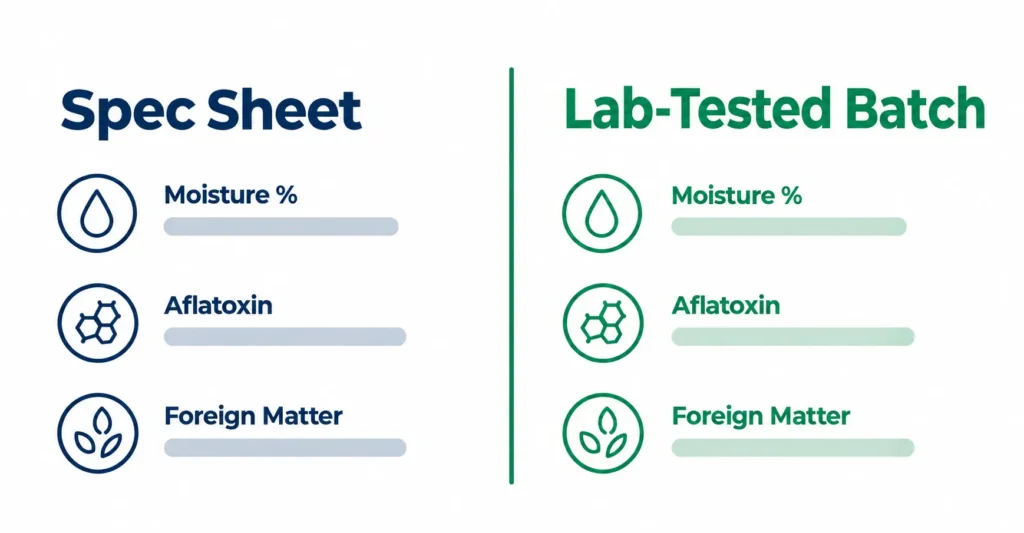
Rejection is rarely about the commodity failing outright. It’s usually about spec drift — the space between the number on the sales contract and the number a lab would actually produce if you tested the container today. Spec drift happens when:
- Grading is done visually by the supplier’s own staff, with no third-party confirmation
- Testing happens once, early in the season, and the result is reused for every subsequent shipment regardless of batch
- Documentation is generated from a template rather than from the specific consignment’s actual test data
- The time between testing and loading is long enough for moisture or pest activity to change the result
None of this requires bad faith. Most exporters aren’t trying to mislead buyers — they simply haven’t built a process that re-verifies every batch. That’s the gap a buyer needs to close before signing a contract, not after a shipment is already at sea.
What Buyers Do That Increases Their Own Risk (Without Realising)
Most procurement managers inherited a supplier relationship rather than building the sourcing process from scratch, so it’s worth naming the specific habits — common, not careless — that quietly raise rejection risk.
Accepting a supplier’s self-reported spec sheet as final proof. A spec sheet written by the seller describes what they intend to deliver. It isn’t independent verification. Buyers who treat it as the final compliance record — rather than as a starting point to be confirmed by third-party testing — are the ones most often surprised at the port.
Not requesting the actual lab report, only the certificate summary. A one-line “passed inspection” certificate tells you less than the underlying lab report, which shows the specific values tested (aflatoxin B1 and total aflatoxins separately, moisture percentage, foreign matter, insect infestation) against the specific batch number. Ask for the full report, not the summary.
Treating Certificate of Origin as a formality. A Certificate of Origin isn’t just proof the goods came from Ghana or Nigeria — customs and EU trade preference schemes check that the document’s HS code, weight, and exporter details match the commercial invoice and bill of lading exactly. A mismatched digit is enough to trigger a hold.
Not asking when the sample was tested relative to the loading date. A test conducted eight weeks before loading tells you very little about a container that sat in a warehouse through a humid season. Ask for testing to be timed close to packing and loading.
Assuming one certification covers every requirement. SGS inspection, NAFDAC/NAQS export certification, and a Phytosanitary Certificate check different things. A shipment can hold a valid SGS quality report and still be missing the Phytosanitary Certificate required for plant-origin products entering the EU or UK.
Skipping a pre-shipment inspection because “we trust this supplier.” Trust is not a customs document. An independent, dated pre-shipment inspection report is what a port health authority actually recognises.
None of this makes a first-time buyer careless — it makes them a first-time buyer. The fix is a checklist, not a personality change.
What a Fully Compliant Shipment Actually Requires
A compliant shipment is the output of a controlled process, not a single inspection at the end. At BV Integrated, this is what the Zero-Rejection Protocol™ checks at each of six stages, from farm to delivery.
1. Sourcing. Commodities are traced to identified farms or aggregators, with harvest and storage conditions recorded. This matters because moisture and aflatoxin risk are largely determined before the commodity ever reaches a processing facility, sourcing controls are the first, and cheapest, point to catch a problem.
2. Grading. Physical grading against the agreed specification — moisture percentage, foreign matter, defective or broken kernel count (for cashew), particle size (for spices like ginger), or bean count and fermentation quality (for cocoa) — happens before packing, not after a buyer complains.
3. Testing. Independent laboratory testing on the specific export batch, not a seasonal average. For nuts, seeds, and cocoa, this typically includes aflatoxin (B1 and total), moisture content, and microbial screening where relevant. Results are matched to the batch number that will appear on every subsequent document.
4. Packaging. Packaging materials, labelling, and net weights are verified against the commercial invoice and, where required under EU aflatoxin labelling rules, marked correctly if the lot is destined for further sorting or processing rather than direct consumption.
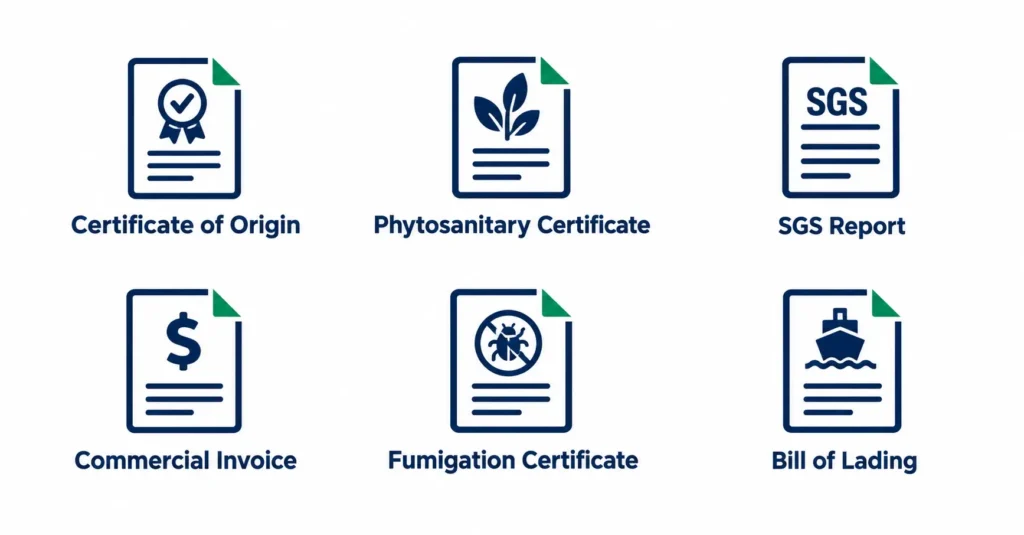
5. Documentation. This is where most shipments actually fail, and where the most value is added. A complete documentation set for a UK- or EU-bound agro-commodity shipment typically includes:
- Certificate of Origin — confirming the country of production, cross-checked against invoice HS codes
- Phytosanitary Certificate — issued by the origin country’s plant protection authority, confirming the shipment is free from regulated pests, required for most plant-origin commodities entering the UK and EU
- SGS or equivalent third-party inspection report — independent verification of quality and quantity against contract specification
- NAFDAC/NAQS export certification (Nigeria-origin shipments) or the equivalent origin-country food safety authority clearance
- Commercial Invoice and Packing List — matched line-for-line with the Certificate of Origin and Bill of Lading
- Fumigation Certificate — where wooden packaging or specific commodity types require it
- Bill of Lading — with consignee, weight, and container details matching every prior document exactly
6. Delivery. Documents travel with the shipment and are pre-shared with the buyer’s clearing agent before the vessel arrives, so any discrepancy is caught and corrected at origin — not discovered by a customs officer three weeks later.
The commercial case for this level of control is straightforward. A single day of container demurrage at a UK port commonly runs into hundreds of pounds, and a held shipment can stall a production line that was scheduled around its arrival. A documentation process built to withstand scrutiny costs far less than the delay it prevents. If you’d like to see how this protocol applies to a specific commodity and volume, our team can walk you through it — get a quote from BV Integrated with your current specification and we’ll tell you exactly what documentation your shipment needs.
A Practical Pre-Shipment Checklist
Use this to evaluate your current supplier, or any new one, before your next shipment leaves origin. This reduces rejection risk — it is not a guarantee, since customs authorities apply discretion and requirements can change by product and destination.
- Request the full lab report, not just a pass/fail certificate. Confirm it shows aflatoxin B1 and total aflatoxins, moisture percentage, and foreign matter separately.
- Confirm the test date is close to the loading date. A gap of more than a few weeks between testing and loading, especially in humid storage conditions, is a risk flag.
- Match the batch number across every document. Lab report, Certificate of Origin, packing list, and Bill of Lading should all reference the same batch or lot number.
- Verify the Phytosanitary Certificate is issued by the origin country’s official plant protection authority, not a private lab, and dated before shipment.
- Check the Certificate of Origin’s HS code against your commercial invoice. A mismatch is one of the most common reasons for a customs hold.
- Ask whether the shipment underwent independent pre-shipment inspection (SGS or equivalent) or only internal supplier grading.
- Confirm packaging labelling complies with EU aflatoxin rules if the lot is intended for further processing rather than direct consumption.
- Share the full document set with your customs clearing agent before the vessel departs, not after arrival, so discrepancies can be corrected at origin.
- Ask your supplier directly what happens if a test result comes back outside specification. A supplier with a defined process (rejection, re-sorting, or renegotiation) is a stronger long-term partner than one who has never had to answer this.
Buyers evaluating a new supplier relationship, or reviewing an existing one against this list, are welcome to send us a current spec sheet — our team will tell you, product by product, what documentation and testing your shipment should carry. Request a quote and compliance review.
Frequently Asked Questions
What is the most common reason African commodity shipments are rejected at UK or EU customs?
The most common reason is a mismatch between documentation and lab-tested reality — such as aflatoxin or moisture levels above EU maximum limits, or a Certificate of Origin that doesn’t match the commercial invoice. Outright contamination is less common than administrative and specification gaps.
What is a Phytosanitary Certificate and do I need one for cashew or sesame imports?
A Phytosanitary Certificate is issued by the exporting country’s official plant protection authority, confirming a shipment is free from regulated pests and diseases. Most plant-origin commodities — including cashew, sesame, and cocoa — require one to enter the UK or EU.
What does an SGS report actually verify?
An SGS (or equivalent third-party) report independently verifies a shipment’s quality and quantity against the agreed contract specification, typically covering moisture, foreign matter, defect count, and weight, based on physical inspection at origin rather than the supplier’s own claims.
What is the EU aflatoxin limit for cashew nuts and other tree nuts?
Under Regulation (EU) 2023/915, raw tree nuts intended for direct human consumption are limited to 4 µg/kg total aflatoxins and 2 µg/kg aflatoxin B1. Nuts destined for further sorting or processing may carry higher limits but must be labelled accordingly.
How long does customs clearance take for African agro-commodity imports to the UK?
Clearance timing varies by commodity risk category and documentation completeness. High-risk food and feed of non-animal origin must clear through a designated Border Control Post, where documentary checks are mandatory and physical or lab checks may extend the timeline if paperwork is incomplete.
What is a Certificate of Origin and why does it get flagged?
A Certificate of Origin confirms the country where goods were produced. It gets flagged when its HS code, weight, or exporter details don’t exactly match the commercial invoice or Bill of Lading — a common but avoidable documentation error.
Can I rely on a supplier’s spec sheet without independent testing?
A supplier’s spec sheet describes an intended specification, not a verified result for a specific export batch. Independent lab testing on the actual consignment being shipped is what customs and port health authorities recognise, not a self-reported document.
What happens if a shipment fails inspection at a UK or EU port?
A failed shipment may be detained at a customs-controlled facility pending further testing, re-exported, or destroyed, depending on the nature and severity of the non-compliance. Costs — demurrage, storage, and lost production time — fall on the importer unless contractually allocated otherwise.
How much does a held container cost a buyer per day?
Demurrage and storage charges vary by port and shipping line, but commonly run into hundreds of pounds per day once free time expires, before accounting for the cost of a stalled production schedule.
What documents should I request before agreeing a contract with a new African commodity supplier?
At minimum: a recent independent lab report matched to a batch number, a valid Phytosanitary Certificate, a Certificate of Origin consistent with invoice details, and confirmation of the supplier’s pre-shipment inspection process. BV Integrated can review a supplier’s documentation set against this standard before you commit.