A container of cashew nuts has cleared payment, cleared the supplier’s own paperwork, and is still sitting at a UK border control post — flagged, unreleased, and racking up demurrage while a production line waits on raw material that was due last week. If that sounds familiar, this isn’t a one-off problem. It’s a pattern, and it has identifiable causes.
This article is for procurement and supply chain managers at UK and EU food manufacturers and importers who buy raw agro-commodities — cashew nuts, soyabeans, sesame seeds, cocoa, ginger, shea butter, hibiscus, charcoal — from African suppliers. It explains exactly why shipments get held at customs, what buyers unknowingly do that raises their own risk, and what a fully compliant shipment actually requires before it ever leaves origin.
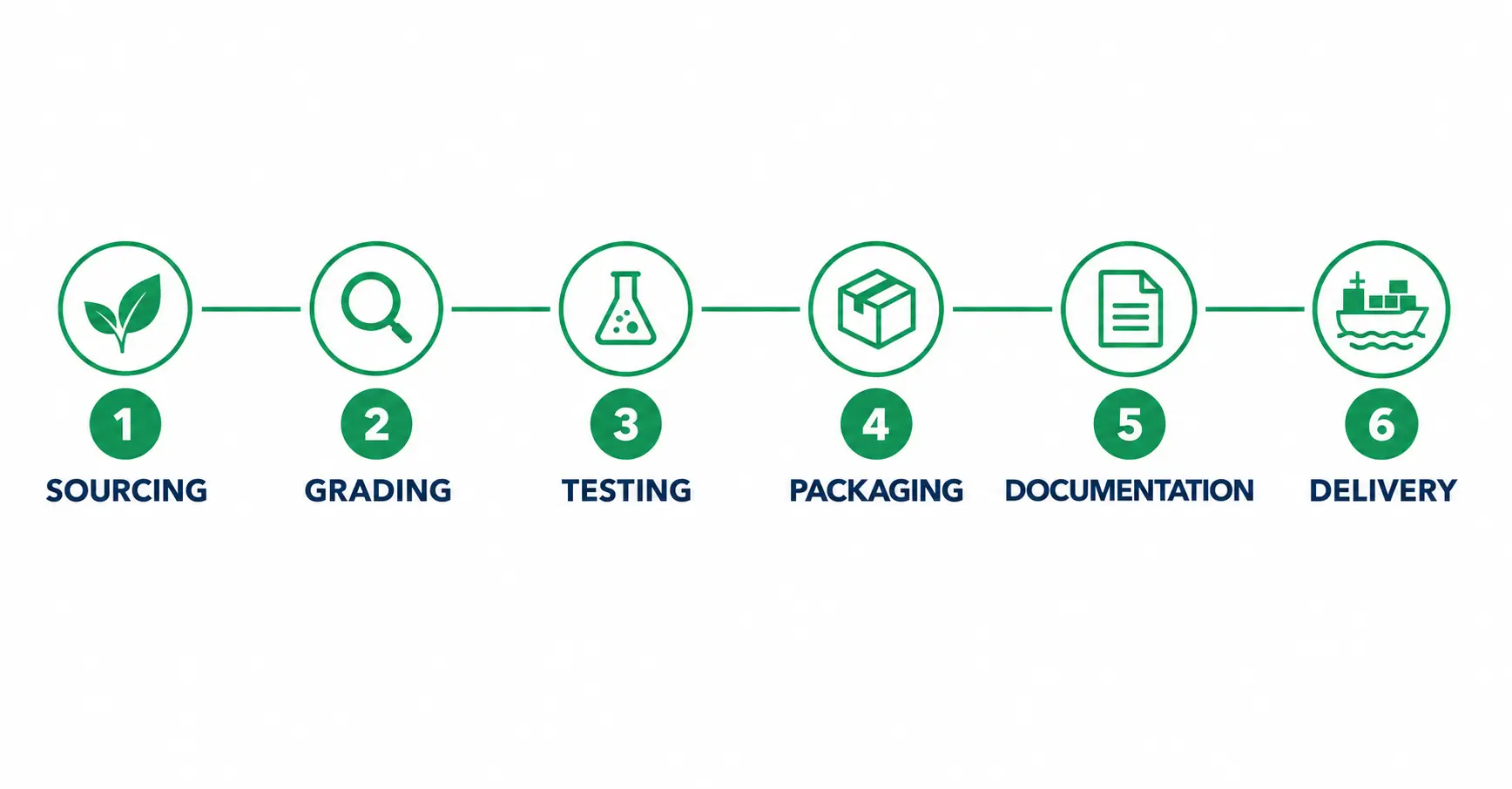
At BV Integrated, we run every export file through the Zero-Rejection Protocol™: six checkpoints — Sourcing, Grading, Testing, Packaging, Documentation, Delivery — built specifically to close the gaps that trigger customs holds. What follows is the operational detail behind that process: not reassurance, but the actual mechanics of why shipments get flagged, and what closes the gap before the container reaches port.
Why Do African Commodity Shipments Get Held at UK & EU Customs?
Agro-commodity shipments are most often held at UK and EU customs for five reasons: missing or incomplete phytosanitary/sanitary certificates, lab results that don’t match the shipment’s spec sheet, errors on the Certificate of Origin, non-compliant packaging or labelling, and contamination levels — typically aflatoxin or moisture — above the receiving country’s legal threshold.
1. Missing or incomplete phytosanitary/sanitary certificates
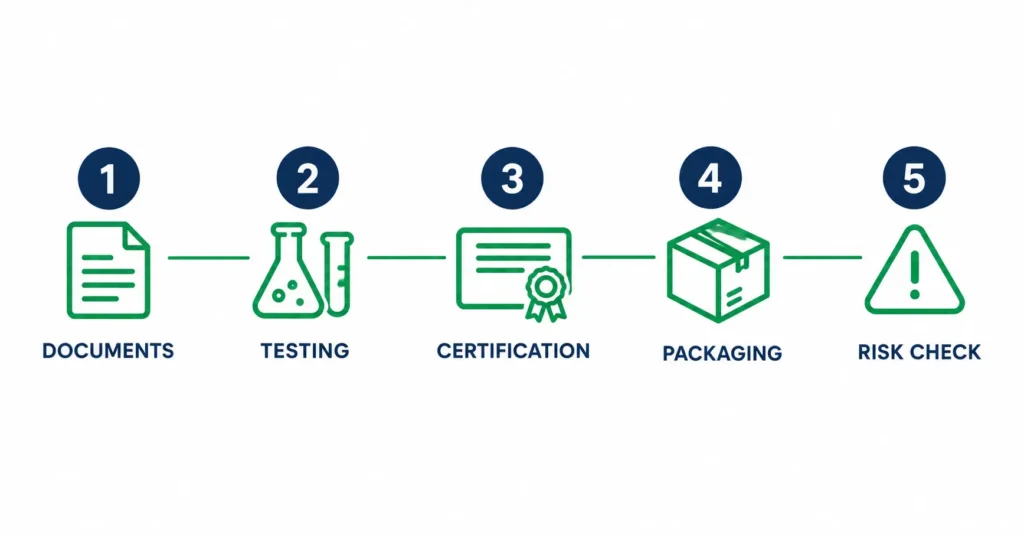
A phytosanitary certificate confirms a plant-origin shipment is free of pests and disease; a sanitary certificate does the equivalent for products with animal-origin elements. Nigeria’s own quarantine authority, NAQS, lists the absence of this certificate — or a certificate with incomplete, mutilated, or altered particulars — as one of the most common causes of export rejection before a shipment even leaves origin. On the receiving end, UK and EU border control posts check for the same document, in the same condition. A certificate issued after the fact, or one that doesn’t match the cargo description line for line, is treated as if it doesn’t exist.
2. Lab results that don’t match the spec sheet
A spec sheet is a claim. A Certificate of Analysis from an accredited, independent lab is evidence. Customs and the buyer’s own quality team are checking the evidence, not the claim — and the two frequently diverge, usually not from deliberate misrepresentation but from testing a different batch, a different harvest window, or no batch at all.
3. Certificate of Origin errors
HS code mismatches between the Certificate of Origin, the commercial invoice, and the packing list are a routine cause of holds. Customs systems flag inconsistency automatically; a human reviewer doesn’t need to suspect fraud to pause a shipment where three documents describe the same cargo three different ways.
4. Non-compliant packaging or labelling
Moisture-barrier packaging, correct net weight declarations, batch/lot codes, and allergen or origin labelling requirements differ by commodity and by destination market. A packaging spec that worked for one buyer in one country doesn’t automatically clear for another.
5. Contamination above the legal threshold
Aflatoxin, moisture content, and pesticide residue are the contaminants most likely to trigger a hold on nuts, seeds, and spices moving into the UK and EU, which apply elevated official controls to specific high-risk food and feed of non-animal origin from specific countries of origin under retained EU Regulation 2019/1793. These thresholds are legal limits, not quality preferences — a shipment can look, smell, and taste correct and still fail on a parameter invisible to the naked eye.
What Actually Happens Before a Shipment Is Flagged
A compliance gap almost never starts at the port. It starts at sourcing or grading, weeks earlier, and stays invisible until a lab test or a document check exposes it. By the time a shipment is flagged, the gap has usually existed since the produce was bought from the farmer or aggregator.
Most buyers assume that if a supplier has sent a spec sheet, a sample, and a photo of bagged produce at the warehouse, the shipment is “fine.” None of those three things verify what’s actually inside the container. A spec sheet reflects what the supplier intends to deliver, or what a previous shipment tested at. A sample can be hand-picked from the best stock in the warehouse rather than drawn at random from the batch being shipped. A photo shows packaging, not contents.
The gap that matters is between the spec sheet a buyer sees once, during negotiation, and what is actually tested batch by batch, shipment by shipment. Aflatoxin levels in nuts and seeds can vary meaningfully between lots from the same farm, let alone between an aggregator’s pooled stock from multiple sources. Moisture content shifts with storage conditions and time elapsed since harvest. A supplier who tested one container three months ago and quotes that result on every subsequent shipment is not lying — they’re reusing stale evidence, and the buyer rarely asks the question that would catch it: which batch was this certificate issued against, and when?
This is also why rejection is rarely about the product failing outright. It’s more often about documentation that doesn’t match the cargo, or a spec that drifted between the sample stage and the shipped stage without anyone re-testing. Grading at origin — sorting, cleaning, moisture-reducing where needed, and testing the specific lot being loaded rather than a representative one from weeks earlier — is the stage where this gap either closes or gets shipped. BV Integrated’s Grading and Testing stages exist specifically to test the batch going into the container, not a batch that resembles it.
What Buyers Do That Increases Their Own Risk (Without Realising)
Buyers most often increase their own rejection risk by accepting a supplier’s self-reported spec without independent verification, not naming a specific lab or testing standard in the purchase order, skipping a Certificate of Analysis per shipment, and not confirming the exporter’s phytosanitary certification is current for that specific consignment.
None of this is a criticism of procurement teams. Most buyers inherited a supplier relationship rather than building a sourcing process from first principles, and nobody hands a new import manager a checklist on day one. The behaviours below are common precisely because they look reasonable in the moment.
Accepting the supplier’s self-reported spec sheet as final. A spec sheet from the exporter is a starting point for negotiation, not a verified result. Without a named independent inspection body — SGS, Bureau Veritas, or an equivalent accredited lab — attached to the actual shipment, there is no third party standing behind the numbers.
Not specifying the testing standard in the purchase order. “Grade A” or “export quality” means nothing enforceable unless the PO names the specific parameters (moisture %, aflatoxin limit, foreign matter %, defect count) and the standard they’ll be measured against. A vague PO gives a supplier room to interpret generously, and gives the buyer no document to point to when a shipment underperforms.
Treating one Certificate of Analysis as valid for every future shipment. A CoA is a snapshot of one batch. Reusing it across multiple containers — or accepting a supplier’s assurance that “it’s the same as last time” — removes the one piece of evidence that would have caught a contamination spike before the container left origin.
Not verifying the exporter’s phytosanitary certificate is current and consignment-specific. A certificate exists; whether it covers this shipment, this batch, and this destination market is a separate question, and one most buyers don’t ask until customs asks it for them.
Accepting generic packaging because it’s cheaper. Moisture-barrier requirements exist because they prevent the contamination that gets tested for later. Packaging cost savings at origin frequently show up as a lab result problem at the border.
What a Fully Compliant Shipment Actually Requires
A fully compliant shipment requires verified sourcing, lot-specific grading and testing, moisture-appropriate packaging, a complete and consistent documentation set — phytosanitary certificate, Certificate of Origin, Certificate of Analysis, commercial invoice, packing list — and a delivery process that keeps all of it aligned to the exact container being shipped. Missing any one stage increases hold risk.
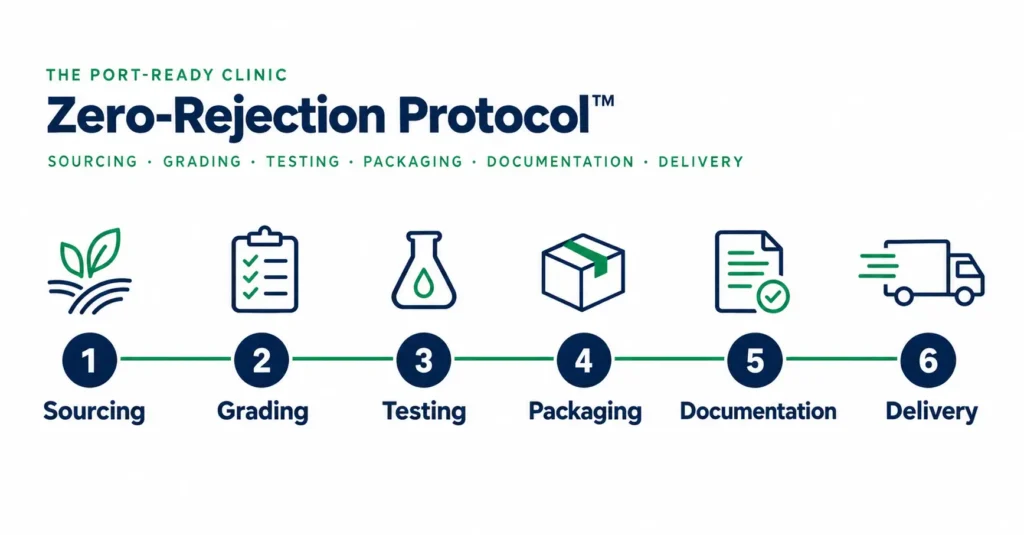
This is the structure behind BV Integrated’s Zero-Rejection Protocol™, and it maps to six sequential checkpoints:
Sourcing — produce is bought from identified origins with traceability back to the farm or aggregator, not pooled from unverified mixed-source stock.
Grading — sorting, cleaning, and moisture correction happen on the specific lot destined for that shipment, against the buyer’s agreed specification.
Testing — an independent Certificate of Analysis is issued against that lot, covering the parameters relevant to the commodity: moisture, aflatoxin, foreign matter, defect count, and others as applicable. Third-party inspection bodies such as SGS offer this as a standard pre-shipment service, including visual inspection, contractual sampling, and documentation review ahead of loading.
Packaging — moisture-barrier packaging, correct net weight, and batch/lot coding appropriate to the commodity and destination market, not a generic default.
Documentation — the full set assembled and cross-checked for consistency: NAQS phytosanitary or sanitary certificate, Certificate of Origin from the relevant Chamber of Commerce, Certificate of Analysis, commercial invoice, and packing list, with HS codes and cargo descriptions matching across every document.
Delivery — the documentation set travels with the shipment and is confirmed against the physical cargo before release, so nothing in the paperwork describes a different container than the one that actually arrives.
The commercial case for this is straightforward: a held container accrues demurrage from the shipping line, and every day it sits unreleased is a day a production line downstream is either running on buffer stock or not running at all. Closing documentation and spec gaps before the vessel sails costs less than discovering them at the border.
Get a quote from BV Integrated →
A Practical Pre-Shipment Checklist
This reduces risk; it isn’t a guarantee that any shipment will clear customs without query — no document set can promise that, and any supplier claiming otherwise is overselling. What it does is close the gaps that cause most holds.
- Confirm the exporter can produce a phytosanitary or sanitary certificate specific to this consignment — not a certificate issued for a prior shipment.
- Request a Certificate of Analysis from an independent, accredited lab for the exact batch being loaded, not a representative sample tested weeks earlier.
- Name the testing parameters and acceptable thresholds in the purchase order — moisture %, aflatoxin limit, foreign matter %, defect count — rather than relying on “export grade” as a catch-all term.
- Cross-check HS codes and cargo descriptions across the commercial invoice, packing list, and Certificate of Origin before the vessel sails, not after a customs query.
- Confirm packaging specification matches the commodity and destination market — moisture-barrier requirements for nuts and seeds differ from those for dried spices or ground products.
- Ask who issues the Certificate of Origin and confirm it’s from a recognised Chamber of Commerce, not a self-issued document.
- Request photographic or video documentation of the grading and loading process, not just the finished, packaged product.
- Build in time for independent pre-shipment inspection rather than treating it as optional on time-pressured orders — this is usually where a spec gap is caught while it’s still cheap to fix.
If your current supplier can’t produce clear answers to items 1 through 6 on request, that’s worth raising before your next purchase order, not after a container is held. BV Integrated runs every shipment through this process by default — if you’d like to compare it against your current sourcing arrangement, request a quote and we’ll walk through what’s covered.
Frequently Asked Questions
Why do cashew or sesame shipments get rejected at UK customs even with a spec sheet?
A spec sheet is the supplier’s claim, not independent evidence. UK customs and food safety checks rely on a Certificate of Analysis from an accredited lab and a valid phytosanitary certificate matching the actual batch shipped — not the figures quoted during negotiation.
What is a phytosanitary certificate and why does it matter for African commodity imports?
A phytosanitary certificate confirms a plant-origin shipment is free of pests and disease, issued by the exporting country’s plant health authority — NAQS in Nigeria. UK and EU border posts check it against the physical cargo before releasing a shipment.
What does an SGS or Bureau Veritas inspection report actually verify?
An independent pre-shipment inspection verifies quantity, packaging and marking, quality against the agreed contract specification, and reviews documentation — providing third-party evidence the buyer and customs can both rely on, separate from the exporter’s own claims.
What is the difference between a Certificate of Origin and a Certificate of Analysis?
A Certificate of Origin confirms where the goods were produced, issued by a Chamber of Commerce. A Certificate of Analysis reports lab-tested results — moisture, aflatoxin, defect count — for that specific batch. Both are required; they answer different questions.
Why does aflatoxin cause more customs holds than almost any other factor?
Aflatoxin is a mould-produced toxin common in nuts, seeds, and some spices, regulated under UK and EU food safety rules and the Codex Alimentarius contaminants standard. It is invisible without lab testing, so it is the parameter most likely to fail unexpectedly even on visually sound produce.
How long does a compliant shipment take from sourcing to UK port arrival?
Timelines vary by commodity, season, and shipping route. What’s consistent is that grading, testing, and documentation at origin should run in parallel with booking and transit — not be rushed in the final week before loading, which is when most spec and document gaps go undetected.
Can a buyer request a specific lab or inspection body for their shipment?
Yes. Naming an independent inspection body — SGS, Bureau Veritas, or an equivalent accredited lab — in the purchase order is standard practice and gives the buyer verified, third-party evidence rather than relying on the exporter’s in-house testing alone.
What happens to a shipment that fails inspection at a UK or EU port?
Outcomes depend on the specific failure and the regulator’s assessment: re-testing, detention pending further checks, or in serious cases refusal of entry. All of these carry demurrage and delay costs, which is why pre-shipment verification at origin matters more than post-arrival remediation.
Do all African agro-commodities face the same level of customs scrutiny in the UK and EU?
No. Certain food and feed of non-animal origin from specific countries of origin are subject to a temporary increase in official controls under retained EU Regulation 2019/1793, meaning scrutiny varies by commodity, origin country, and current risk designation — not a flat rule applied to all African imports.
What’s the single most effective step a first-time importer can take to reduce rejection risk?
Request an independent Certificate of Analysis for the exact batch being shipped, not a prior batch or a supplier’s self-reported figures. This one document closes the gap behind most undetected spec and contamination issues.