A container of raw cashew kernels sits at a UK border control post. The documents look complete. The shipment still gets flagged, and a production run booked to start in nine days is now waiting on a decision nobody can give a date for.
This guide is for procurement and supply chain managers at UK and EU food manufacturers who are comparing Nigeria and Ghana as cashew nut origins, and who want to know, in specification terms, what actually separates a shipment that clears customs from one that doesn’t. It is not a pitch for one country over the other — both are credible origins with different operational risk profiles, and the right choice depends on what a buyer’s own verification process can catch.
BV Integrated Ltd sources and exports cashew nuts and other agro-commodities from Nigeria, and runs every shipment through a six-stage Zero-Rejection Protocol — Sourcing, Grading, Testing, Packaging, Documentation, Delivery — built around the same checks UK and EU border posts run on arrival. What follows is the comparison those checks are based on.
Why Do African Commodity Shipments Get Held at UK and EU Customs?
Shipments are most often held for one of three reasons: aflatoxin levels above the limits set in Regulation (EU) 2023/915, a missing or incomplete phytosanitary or sanitary certificate, or a mismatch between the supplier’s spec sheet and what inspectors find in the container. None of these are product failures in the sense most buyers assume — they are verification failures, and they are preventable.
Cashews fall under the EU’s “other tree nuts” aflatoxin category. The regulation sets a lower ceiling for nuts going straight to the final consumer or into food as an ingredient than for nuts still awaiting sorting or physical treatment, so the same raw cashew lot can be compliant or non-compliant purely on the basis of whether it has already been through a proper sorting and testing stage before export. A supplier who skips that stage isn’t necessarily selling a worse nut — they’re selling an untested one, and the test happens either before the container leaves port or after it’s already arrived, delayed, and costing someone demurrage.
In Great Britain, high-risk food and feed of non-animal origin, a category that includes tree nuts, can only enter through a Border Control Post, where documentary checks are mandatory and physical checks can be triggered on a risk basis. The UK Food Standards Agency is explicit that aflatoxin contamination in nuts, spices and dried fruit is one of the specific risks this checking regime exists to catch. A shipment arrives at a BCP already carrying a presumption of scrutiny; the paperwork is what moves it through quickly or stalls it.
On the Nigerian side, the Nigeria Agricultural Quarantine Service (NAQS) publishes its own list of the most common causes of export rejection, and the list is dominated by documentation failures rather than product defects: absence of a sanitary or phytosanitary certificate, incomplete information on the certificate, forged or altered certificates, concealment of uncertified items within a certified consignment, and failure to give advance notification where the destination country requires it. In other words, the agency responsible for certifying Nigerian agro-exports is telling exporters, directly, that paperwork discipline is the primary lever on rejection risk — not crop quality.
For a buyer comparing Nigeria and Ghana, the practical takeaway is the same regardless of origin: a shipment is held when the chain of evidence behind it is incomplete, not when the nut itself is bad. The next three sections look at where that chain of evidence typically breaks.
What Actually Happens Before a Shipment Is Flagged
A compliance gap almost never starts at the port. It starts at the sourcing or grading stage, weeks earlier, in a form that’s invisible until someone actually tests for it.
Raw cashew nuts move through several hands before they reach an exporter’s warehouse: smallholder farmers, local aggregators, and sometimes informal cross-border traders. At each handoff, moisture content, foreign matter levels and batch provenance can drift from what was recorded at the farmgate. A buyer looking at a spec sheet sees a single set of figures. What was actually tested, on what date, on which sub-lot, is a separate question the spec sheet doesn’t answer on its own.
The scale of this problem differs by origin in ways that are worth naming plainly. Nigeria’s National Cashew Association has reported that the country’s raw cashew production reached roughly 400,000 tonnes in the 2024 season, making it the second-largest producer in West Africa, with first-half 2025 export earnings up more than 80% year-on-year to around $398 million. But trade analysts covering the sector have also estimated that close to half of Nigeria’s raw cashew volume moves through informal cross-border channels rather than formal, traceable export routes — meaning a meaningful share of regional supply never passes through a documented chain of custody at all. That doesn’t mean every Nigerian supplier has a traceability problem; it means traceability is something a buyer has to verify supplier by supplier, not assume.
Ghana’s exposure runs differently. Ghana’s 2024 raw cashew harvest fell to around 161,000 tonnes, down roughly 30% on the 230,000 tonnes produced in 2023, largely due to weather. Ghana’s Tree Crop Development Authority has separately warned exporters and intermediaries against shipping raw cashew nuts without proper registration or licensing, which points to the same underlying issue from a different angle: in a tighter supply year, the pressure to move unverified or unlicensed volume through export channels rises. Over 90% of Ghana’s raw cashew output is still exported unprocessed, with only a small share handled by domestic processing capacity, so the vast majority of the crop reaches export in a form where origin and condition verification happens off-farm, at the exporter or aggregator level.
What buyers typically assume is “fine” because it’s written down — moisture percentage, kernel count, a harvest date — is frequently a figure carried forward from an earlier stage in the chain rather than a result from independent testing of the specific lot being shipped. A rejection at a UK or EU border is rarely about the cashew itself failing a test outright; it’s about a gap between what the documentation claims and what an inspector can independently verify when they open the container. That gap is what the next section looks at from the buyer’s side.
What Buyers Do That Increases Their Own Risk (Without Realising)
Most first-time importers haven’t been shown what to check, because most supplier relationships are inherited rather than built from a sourcing process designed in-house. The behaviours below are common, not careless — but each one widens the gap between a spec sheet and what customs actually finds.
Accepting a supplier’s self-reported spec without third-party verification. A spec sheet produced by the seller is a sales document until an independent inspector confirms it. SGS and other independent inspection bodies offer pre-shipment verification specifically because a self-certified spec and a verified spec are not the same category of evidence to a customs officer.
Treating a phytosanitary certificate as a quality certificate. A phytosanitary certificate confirms a shipment is free of regulated pests and diseases. It says nothing about aflatoxin levels, moisture content or kernel grade. Buyers who see “certified” on a shipping document sometimes stop asking what, specifically, was certified.
Skipping split or counter-sampling. Relying on a single sample drawn and tested by the seller, with no independent counter-sample held or tested by the buyer’s own inspector, means there’s no way to catch a discrepancy between the sample and the bulk lot before the container is already at sea.
Not confirming harvest date and storage duration. Raw cashew nuts are an agricultural product with a shelf life; moisture migrates and aflatoxin risk rises with poor storage over time. A spec sheet with no harvest date, or one that’s clearly stale relative to the shipment date, is a gap worth asking about before paying a deposit.
Assuming a lower price reflects negotiation skill rather than a skipped step. A quote that undercuts the market by a wide margin sometimes reflects efficient sourcing. It sometimes reflects a supplier who hasn’t paid for independent testing, proper fumigation, or correctly issued certificates, and is passing that saved cost on as a lower price with the risk passed on too.
Working from Incoterms without checking who holds inspection responsibility. FOB and CIF terms govern cost and risk transfer for freight; they don’t by default specify who commissions pre-shipment inspection or in what form. Buyers sometimes assume inspection is included somewhere in the commercial terms when it was never explicitly agreed.
None of this is a reason to distrust African suppliers as a category. It’s a reason to treat verification as a step the buyer commissions independently, rather than a step the buyer takes on faith from the seller’s own paperwork.
What a Fully Compliant Shipment Actually Requires
A shipment that clears UK or EU customs without incident has usually passed through six distinct checkpoints before it ever reaches a port. BV Integrated structures its own export process around these checkpoints as a Zero-Rejection Protocol, not because any exporter can guarantee zero rejections, but because each stage closes one of the specific gaps described above.
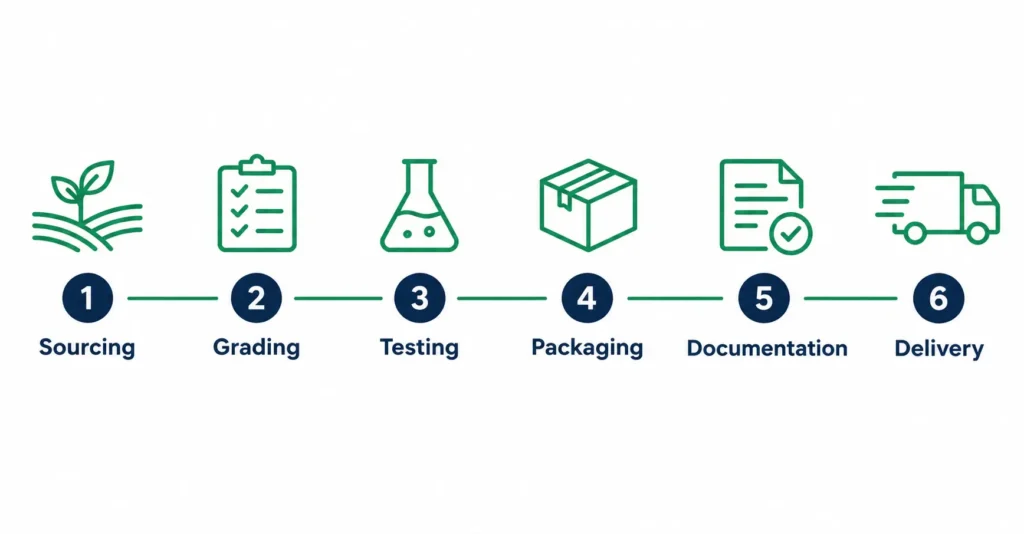
1. Sourcing. Raw cashew nuts are sourced from aggregators and farm groups with recorded harvest dates and traceable batch origin, rather than pooled anonymously from mixed-origin stock. Traceability at this stage is what makes every later test meaningful — a verified result is only as good as the certainty that it was drawn from the lot actually being shipped.
2. Grading. Nuts are graded against the buyer’s agreed specification — moisture content, kernel outturn, count per kilogram, foreign matter and defect thresholds — before the lot is accepted into the export batch, not after a buyer has already raised a complaint.
3. Testing. Independent laboratory testing confirms aflatoxin levels against the limits in Regulation (EU) 2023/915, alongside moisture and contaminant checks. Where a buyer requests it, an independent inspection body such as SGS can conduct pre-shipment verification and split sampling, giving the buyer a counter-sample tested outside the exporter’s own chain.
4. Packaging. Packaging and marking are checked against both the buyer’s contractual requirements and destination-market labelling rules, including lot identification that ties the physical bags back to the tested batch.
5. Documentation. A compliant Nigerian cashew shipment typically travels with: a Phytosanitary Certificate issued by NAQS confirming the consignment is free of regulated pests; an independent inspection or quality report (commonly from a body such as SGS) confirming the lot meets agreed specification; a Certificate of Origin; a Fumigation Certificate where required by the destination market; and a complete, consistent set of commercial documents — invoice, packing list and bill of lading — with no discrepancies between them. NAQS’s own published guidance lists incomplete or inconsistent documentation as a leading cause of rejection, which is why consistency across every document, not just the presence of each one, is checked before the container is sealed.
6. Delivery. Shipment tracking and pre-arrival document sharing mean the buyer’s customs broker has the full certificate set in hand before the container reaches a UK or EU Border Control Post, rather than scrambling to source a missing document after the shipment has already been flagged for a documentary check.
The commercial case for this is straightforward: a flagged container accrues demurrage from the shipping line, and a production line waiting on raw material loses output for every day the hold continues. Verification costs money before the shipment leaves port. A hold costs more after it arrives. Get a Quote.
A Practical Pre-Shipment Checklist
This isn’t a guarantee of zero rejection — no exporter can honestly offer one. It’s a risk-reduction checklist a buyer can run against their current or prospective cashew supplier today, regardless of which origin they’re sourcing from.
- Request the harvest date and storage duration for the specific lot, not a general statement about the season’s crop.
- Ask who conducted the aflatoxin and moisture testing, and whether the lab is independent of the seller.
- Request a counter-sample or independent split sample you can have tested by your own inspector before final payment.
- Confirm which certificates will travel with the shipment — Phytosanitary Certificate, Certificate of Origin, Fumigation Certificate where applicable, and an independent inspection report — and ask to see a template or a prior example.
- Cross-check the documents against each other for consistent weights, lot numbers and dates before the container is sealed, not after it arrives.
- Clarify, in writing, who is responsible for commissioning pre-shipment inspection under your Incoterms — don’t assume it’s included.
- Ask for the supplier’s traceability process from farmgate or aggregator through to export lot, in plain terms.
- Build in a realistic lead time that includes testing and certification, not just transit time, so a documentation delay doesn’t collide with a fixed production date.
If a supplier can answer all eight points clearly and in writing, the shipment is being built on verified ground rather than a sales sheet. Request a quote and compliance documentation pack.
Frequently Asked Questions
What’s the main quality difference between Nigerian and Ghanaian cashew nuts?
Both origins produce cashews that can meet UK and EU specification when properly graded and tested. The practical difference buyers report is less about the nut itself and more about supply-chain traceability: Nigeria’s larger, more fragmented production base versus Ghana’s smaller, more tightly licensed export channel following its 2024 production decline.
What aflatoxin level is acceptable for cashew nuts entering the EU?
Cashews fall under the EU’s “other tree nuts” category in Regulation (EU) 2023/915. The regulation sets separate, lower ceilings for nuts intended directly for the final consumer than for nuts still awaiting sorting or further treatment, so the applicable limit depends on the product’s stage at import.
What is a phytosanitary certificate and do I need one for cashew nuts?
It’s an official document confirming a plant-based shipment is free of regulated pests and diseases, issued by the exporting country’s plant protection authority — NAQS in Nigeria’s case. It’s a standard requirement for raw cashew exports and is checked at UK and EU Border Control Posts.
Does a phytosanitary certificate guarantee cashew quality?
No. It confirms freedom from regulated pests and diseases only. It says nothing about aflatoxin levels, moisture content or kernel grade, which require separate laboratory testing and an independent quality or inspection report.
Why do cashew shipments get held at UK Border Control Posts?
High-risk food and feed of non-animal origin, including tree nuts, is only permitted through designated Border Control Posts, where documentary checks are mandatory and physical checks can follow. Aflatoxin contamination is one of the specific risks the UK Food Standards Agency names for this product category.
What is a Certificate of Origin and why does a buyer need one?
It confirms the country in which the goods were produced, supporting correct tariff treatment and customs clearance. It’s typically issued alongside the phytosanitary certificate and commercial documents as part of a complete export document set.
Can a buyer request independent inspection before a cashew shipment leaves port?
Yes. Independent bodies such as SGS offer pre-shipment inspection services for agricultural commodities, including sampling, quality testing and documentation review, commissioned by either the buyer or the seller ahead of loading.
What should a first-time cashew importer ask a new supplier before placing an order?
Ask for the harvest date of the specific lot, who conducted aflatoxin and moisture testing, whether an independent counter-sample is available, and which certificates will accompany the shipment — then confirm the answers in writing before paying a deposit.
How much does a held shipment typically cost in demurrage and downtime?
Costs vary by shipping line, port and contract terms, so there’s no single reliable figure to quote. What’s consistent is that demurrage accrues daily once a container is held, and a production line waiting on raw material loses output for every day the delay continues — which is why verification before departure is cheaper than resolution after arrival.
Is Nigeria or Ghana a more reliable cashew export origin for UK and EU buyers?
Reliability depends more on the individual supplier’s verification practices than on country of origin alone. A Nigerian or Ghanaian exporter who runs independent testing, issues complete documentation and can demonstrate batch traceability is a lower-risk counterparty than an unverified supplier from either country.