A container sits at Felixstowe or Rotterdam with a customs hold flag against it. Your production line is three days from running out of raw material, and nobody on your side can tell you exactly why the shipment stopped moving. If that scenario feels familiar, this article is for you.
This guide is written for procurement and supply chain managers at UK and EU food manufacturers who source raw agro-commodities — cashew nuts, sesame seeds, soyabeans, cocoa, ginger, shea butter, hibiscus, charcoal — directly or indirectly from Africa. It answers two questions at once: which African sourcing countries and suppliers actually reduce your risk, and what a shipment needs to contain before it ever reaches a port, so it doesn’t become a customs statistic.
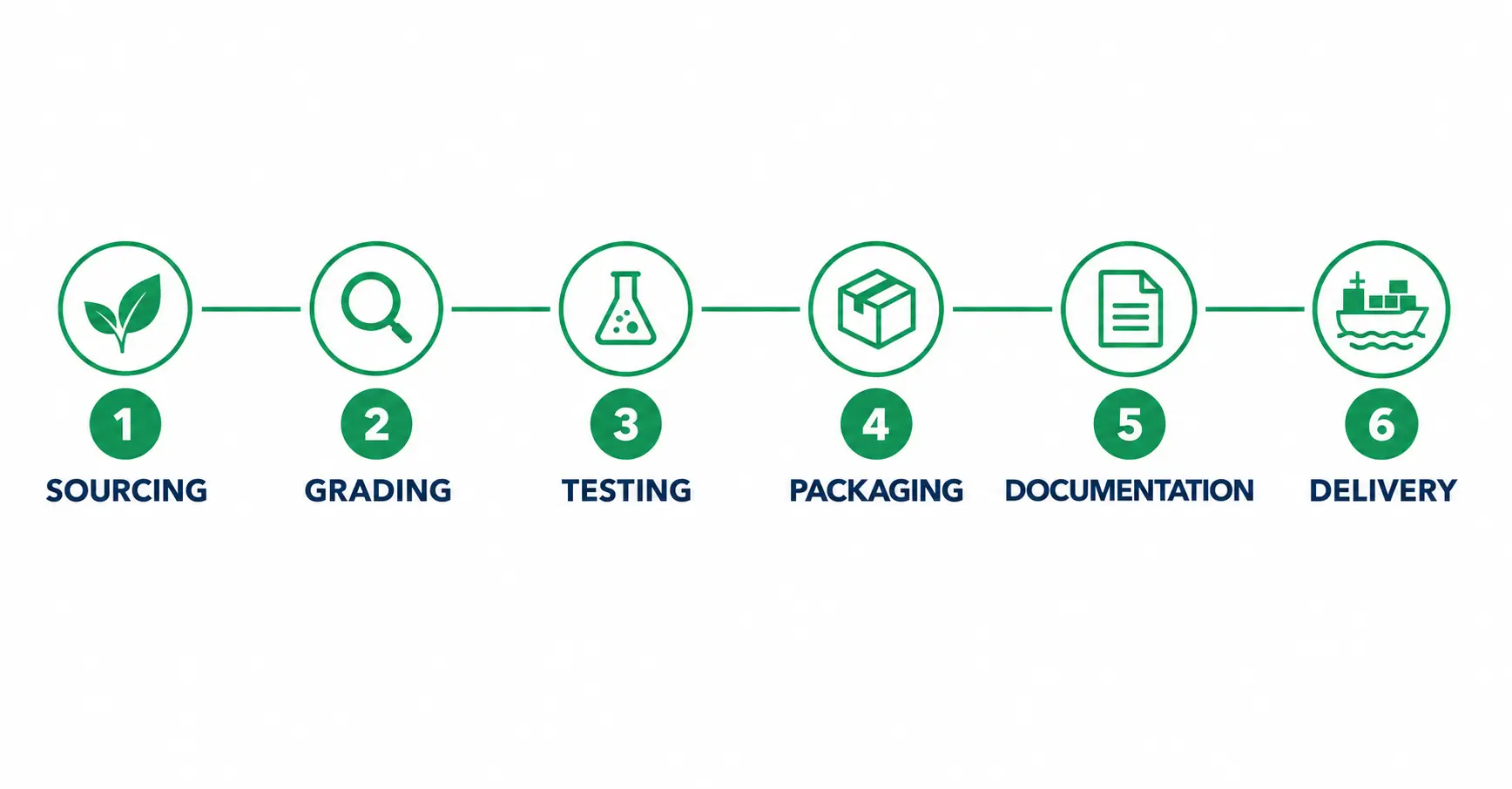
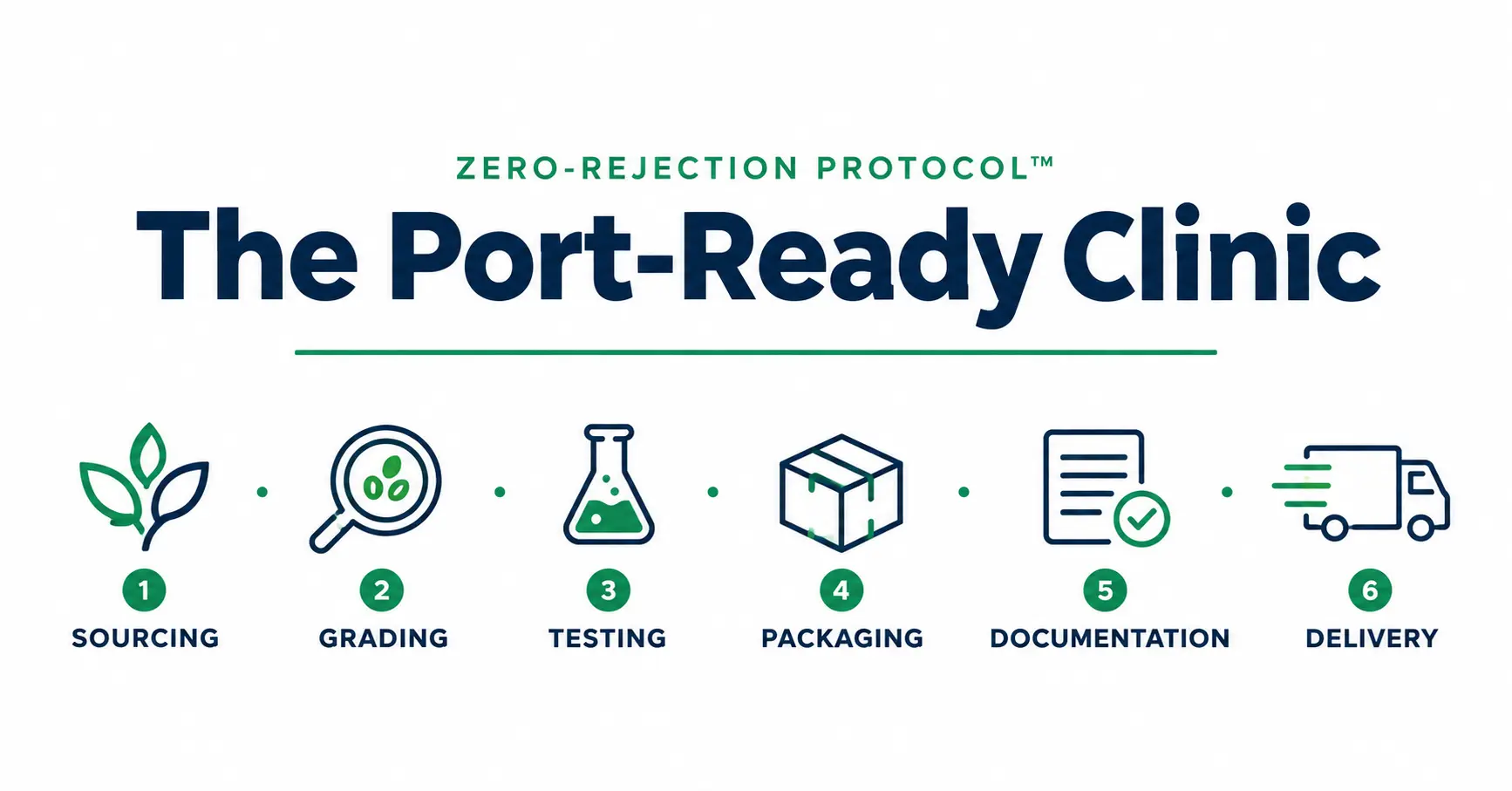
Every recommendation here reflects how BV Integrated Ltd runs its own sourcing operation: a UK-registered agro-commodity exporter that sources directly from Nigeria and applies a six-stage internal framework — Sourcing, Grading, Testing, Packaging, Documentation, Delivery — to every consignment before it leaves the country of origin. We call it the Zero-Rejection Protocol™, not because rejection is impossible, but because it is the specific set of checks that remove nearly every cause of rejection we’ve seen in practice.
Why Do African Commodity Shipments Get Held at UK & EU Customs?
Shipments get held when the paperwork accompanying the goods doesn’t fully match what’s inside the container, or when a required certificate — phytosanitary, Certificate of Origin, lab test report — is missing, expired, or inconsistent with the declared consignment details. The product itself is frequently within spec; the hold is a documentation or verification failure, not necessarily a quality failure.
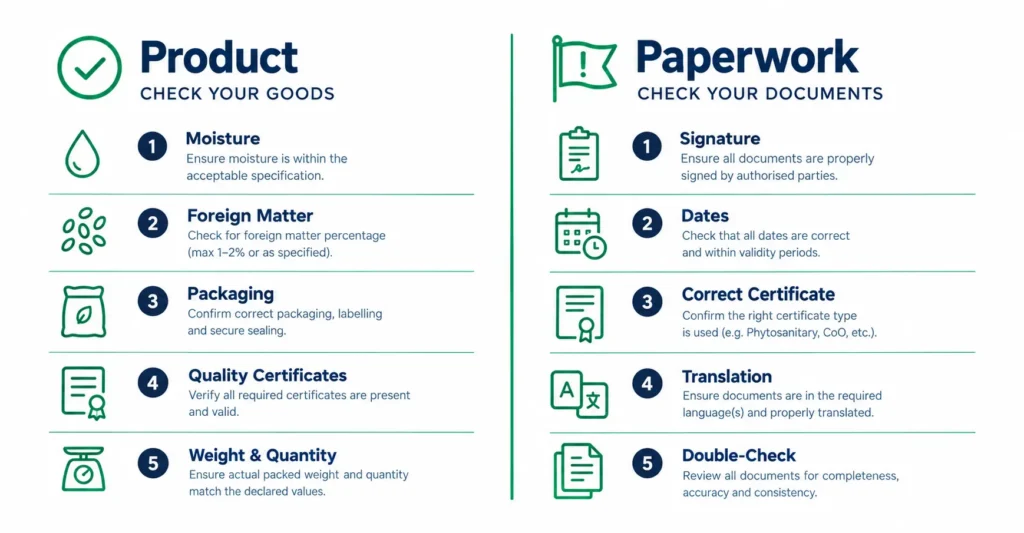
Under the UK’s Border Target Operating Model and the EU’s equivalent SPS framework, certain plant-origin foodstuffs are subject to increased checks at the border, and officials are working from the paper trail first, the physical product second. A mismatch between the Certificate of Origin and the commercial invoice, a phytosanitary certificate issued outside its validity window, or a lab report that doesn’t specify the exact test method used against a named standard — any of these can trigger a hold regardless of whether the cashews or sesame inside the container are perfectly sound. Buyers who assume “good product in, good product out” are solving half the problem.
What Actually Happens Before a Shipment Is Flagged
A compliance gap is almost never created at the port. It’s created weeks earlier, at the point where a spec sheet is agreed and nobody independently verifies it against the actual harvest lot.
Here’s the operational reality most buyers don’t see. A supplier quotes a moisture content, a foreign matter percentage, an aflatoxin level — figures that may be accurate for one sample, one bag, one day’s harvest. Commodities like cashew and sesame are aggregated from many smallholder lots before export. Moisture content in particular can shift meaningfully between the point of grading and the point of container loading, especially in humid coastal storage. A spec sheet is a snapshot; a shipment is an accumulation of thousands of individual lots, and drift between the two is the normal condition, not the exception.
What buyers typically assume is “fine” — because it was fine on the certificate — is the foreign matter content, the moisture reading, and sometimes the aflatoxin level by the time the container is sealed weeks or months later. This is why pre-shipment inspection exists as a distinct discipline from origin certification: independent verifiers like SGS conduct contractual sampling and quality testing specifically because self-reported supplier data and delivered reality routinely diverge.
The gap, in short, is between what’s written and what’s tested batch by batch, on the actual lot being loaded — not a lot from three weeks earlier.
How African Sourcing Countries Compare for Buyer Risk
No single African country is uniformly “safest” to source from — risk sits at the supplier level, not the national level — but national infrastructure differences (port efficiency, quarantine digitisation, certification turnaround) do materially change how predictable your lead times and documentation will be.
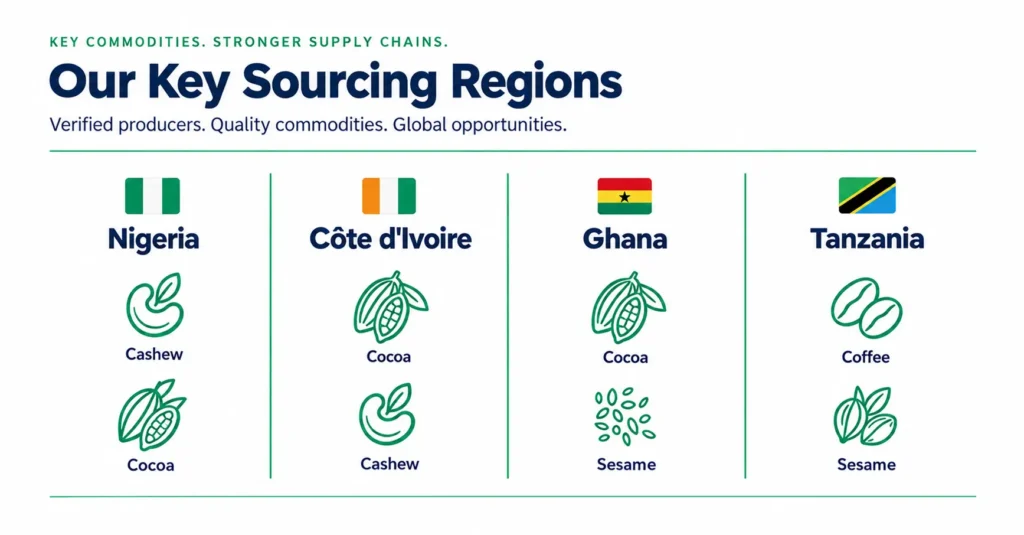
For the commodities most relevant to UK/EU food manufacturers, four origins dominate sourcing conversations:
| Factor | Nigeria | Côte d’Ivoire | Ghana | Tanzania/East Africa |
|---|---|---|---|---|
| Strongest for | Sesame, cashew, ginger, hibiscus, shea, charcoal | Cocoa, cashew | Cocoa, shea | Sesame, cashew (secondary) |
| Phytosanitary process | NAQS — now issuing electronic phytosanitary certificates via the IPPC’s GeNS ePhyto platform | State-run cocoa board certification, cocoa-specific | Cocoa Board (COCOBOD) origin verification | National plant protection organisations, variable digitisation |
| Port congestion risk | Moderate to high at Lagos/Apapa; mitigated by advance booking | Moderate at Abidjan | Lower relative congestion at Tema | Variable by port |
| Buyer implication | Deep product range in one origin; documentation quality now depends heavily on using an exporter that pre-verifies lots, not just the certificate | Strong for single-commodity cocoa buyers; less relevant outside cocoa/cashew | Strong single-origin cocoa reliability | Useful for diversification, less mature export-compliance infrastructure for some commodities |
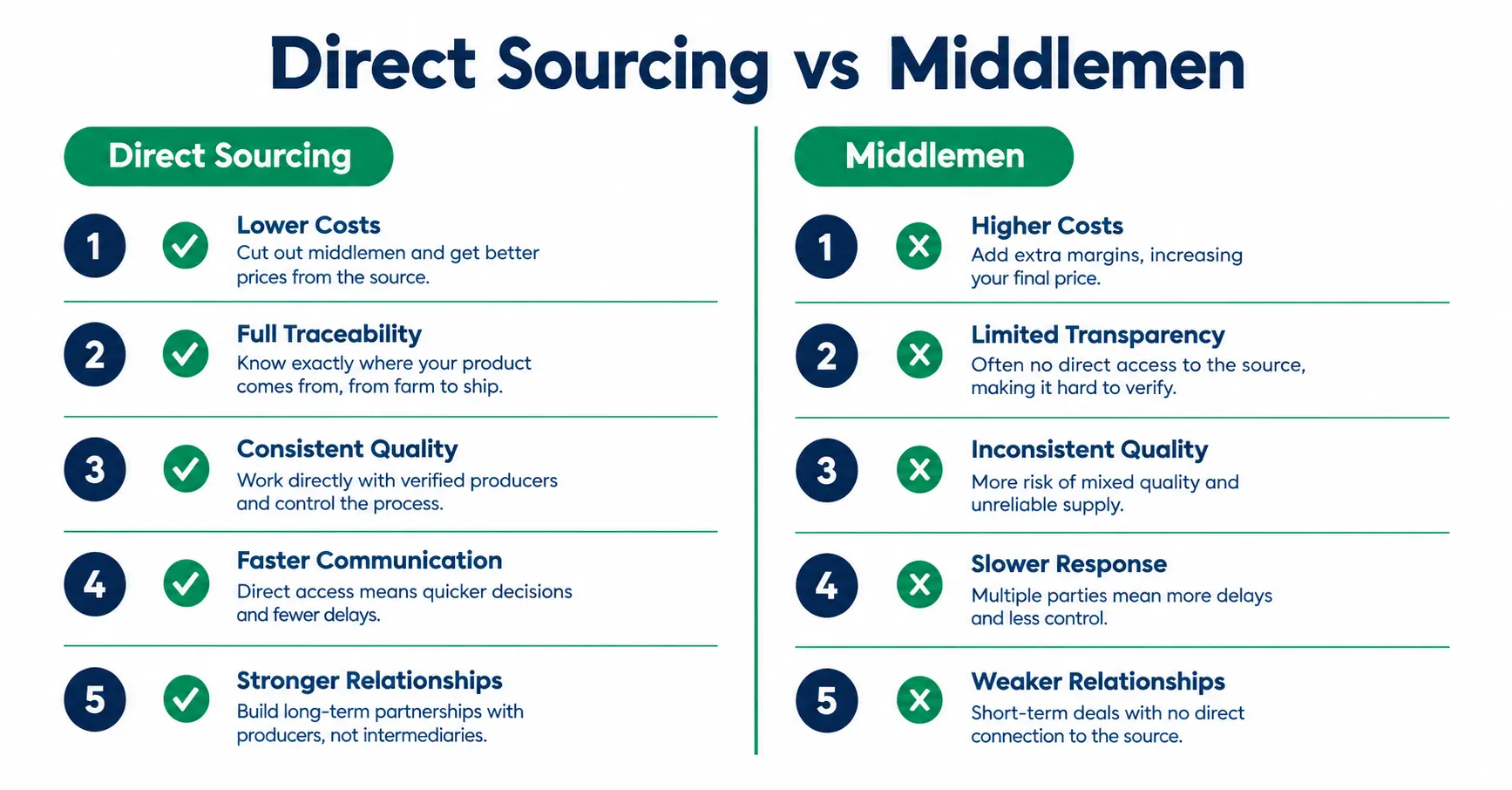
The comparison that actually matters for a procurement manager isn’t “which country” in isolation — it’s which exporter, in which country, runs independent lot-level testing before the Certificate of Origin and phytosanitary paperwork are issued. A Nigerian exporter running third-party SGS verification on every consignment is a lower-risk sourcing decision than an exporter in any country relying solely on self-reported specs. Country selection narrows your options to where your commodity is actually grown at scale; supplier due diligence is what actually determines whether your shipment clears customs on the first attempt.
BV Integrated sources directly from Nigerian growing regions across nuts, seeds, spices, beans, and other commodity lines, applying the same verification protocol regardless of product — see our full product range for current specifications by commodity.
What Buyers Do That Increases Their Own Risk (Without Realising)
Most first-time importers haven’t been shown what to check — this isn’t a knowledge gap they should feel embarrassed about, it’s a gap in how the industry typically communicates with new buyers.
The behaviours that quietly raise risk are specific and common:
- Accepting a supplier’s self-reported spec sheet as the final word, without commissioning independent third-party sampling on the actual lot being shipped, not a reference sample from an earlier batch.
- Treating the Certificate of Origin as a formality rather than cross-checking that its stated quantities, HS code, and description match the commercial invoice and packing list exactly — discrepancies here are a routine trigger for documentary holds.
- Not confirming certificate validity windows. A phytosanitary certificate issued too far in advance of the actual shipment date, or one that doesn’t match the vessel and container details at loading, can be rejected as stale even if the product itself is fine.
- Skipping a pre-shipment inspection to save cost or time, especially on a first order with a new supplier — precisely the shipment with the least established track record and the highest reason to verify independently.
- Not asking which testing standard was used. “Tested for aflatoxin” means little without knowing which method (e.g., ELISA vs HPLC) and against which threshold (EU Regulation 2023/915 sets specific maximum levels that differ from other markets).
None of these require deep technical expertise to fix. They require asking for the underlying test report, not just the summary spec, and building independent verification into the order process as standard — not as an extra step reserved for large or repeat orders.
What a Fully Compliant Shipment Actually Requires
A shipment that consistently clears customs isn’t lucky — it has passed through a defined sequence before it ever reaches a port, and every stage produces a document or a test result that the next stage depends on.
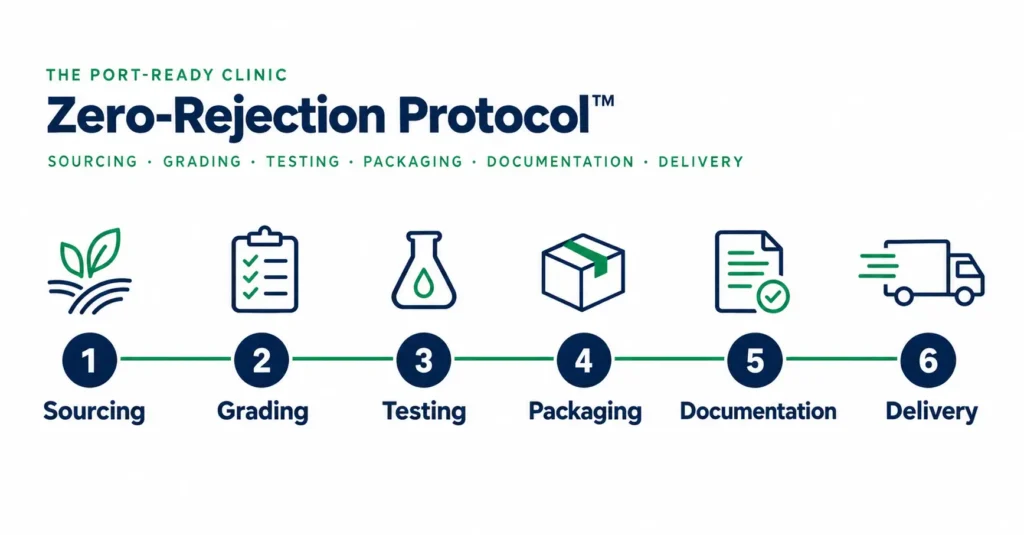
This is the logic behind BV Integrated’s Zero-Rejection Protocol™:
- Sourcing — Lots are sourced from growing regions and aggregation points with traceable origin, not blended from unverified bulk stock.
- Grading — Physical grading against the agreed commercial specification (moisture, foreign matter, defect count, size/count for products like cashew) happens on the actual lot, not a reference sample.
- Testing — Independent laboratory testing covers the parameters that matter for the destination market — aflatoxin levels against EU Regulation 2023/915 thresholds where applicable, moisture content, and microbiological parameters where relevant to the commodity.
- Packaging — Packaging materials and labelling are matched to the certificates being issued; a mismatch between what’s on the bag and what’s on the phytosanitary certificate is itself a rejection cause.
- Documentation — Certificate of Origin, phytosanitary certificate (issued by NAQS in Nigeria, increasingly via the IPPC’s electronic GeNS platform), SGS or equivalent inspection report, and commercial documents are compiled and cross-checked against each other for consistency before the shipment leaves origin.
- Delivery — Shipment tracking and final documentation handoff are timed so the buyer has the full document set in hand before the vessel arrives, not after.
The commercial logic is straightforward: a container held at port accrues demurrage charges from the shipping line and detention charges on the container itself, typically from a matter of days into five figures in total cost depending on the port and duration — on top of the production downtime the delay causes. The cost of independent testing and proper documentation at origin is a fraction of the cost of a single held shipment. This is the section worth forwarding to whoever in your organisation signs off on supplier onboarding.
For a full breakdown of documentation and inspection support, see BV Integrated’s export and trade compliance services and company background.
A Practical Pre-Shipment Checklist
Use this to audit your current supplier relationship today, not just for future orders.
- Request the actual lab test report, not just a spec summary — confirm the test method and the date it was performed relative to your shipment.
- Confirm the phytosanitary certificate’s issue date and validity window against your actual loading and shipping schedule.
- Cross-check the Certificate of Origin, commercial invoice, and packing list for matching HS codes, quantities, and product descriptions.
- Verify who performed the pre-shipment inspection — an independent third party (SGS, Bureau Veritas, or equivalent), not solely the exporter’s own internal QC.
- Ask which aflatoxin and contaminant thresholds the product was tested against, and confirm they match your destination market’s regulation (EU Regulation 2023/915 for EU-bound cargo, the UK’s equivalent retained standards for UK-bound cargo).
- Check packaging and labelling consistency against what’s declared on the certificates.
- Confirm container loading and sealing was photographed or independently witnessed, particularly for a new supplier relationship.
- Build in lead time for documentation review before the vessel departs, not after it’s already at sea.
If any of these checks reveal a gap with your current supplier, or you’re evaluating a new sourcing relationship for Q1 volumes, request a quote from BV Integrated and we’ll walk through your current specification against the Zero-Rejection Protocol™ stages directly.
Frequently Asked Questions
What is the most common reason African commodity shipments are rejected at UK or EU customs?
The most common reason is a documentation mismatch or missing certificate — not product quality. A phytosanitary certificate outside its validity window, or details that don’t match between the Certificate of Origin and commercial invoice, triggers holds more often than the physical product failing inspection.
What certificates does a compliant agro-commodity shipment need?
At minimum: a phytosanitary certificate from the exporting country’s plant protection authority, a Certificate of Origin, a commercial invoice and packing list, and an independent pre-shipment inspection report covering quality and contaminant testing relevant to the commodity.
How is aflatoxin tested in commodities like cashew and sesame?
Aflatoxin is typically tested using ELISA screening or HPLC confirmatory methods against a named regulatory threshold. For EU-bound shipments, EU Regulation 2023/915 sets the applicable maximum levels; buyers should confirm which method and threshold a supplier’s report references.
Is Nigeria a reliable country to source cashew, sesame, and ginger from?
Nigeria produces significant volumes of cashew, sesame, and ginger, and its phytosanitary authority (NAQS) now issues electronic certificates via the IPPC’s GeNS platform. Reliability at the shipment level still depends on the individual exporter’s verification practices, not the country alone.
What is a phytosanitary certificate and why does it matter for food manufacturers?
A phytosanitary certificate confirms a plant-origin shipment is free of regulated pests and diseases, issued by the exporting country’s designated authority. Without a valid one matching the shipment details, customs authorities in the UK and EU can hold or refuse entry to the consignment.
How much does a held shipment typically cost a buyer?
Costs stack from two sources: demurrage charged by the shipping line for the container beyond its free period, and detention charges on the container itself, alongside the buyer’s own production downtime. The exact figure varies by port and duration, but it consistently exceeds the cost of pre-shipment testing that would have prevented the hold.
Should first-time importers use a pre-shipment inspection service even if the supplier provides their own quality report?
Yes. A supplier’s self-reported quality report reflects what they observed on their own sample; an independent inspection verifies the actual lot being loaded against agreed specifications, which is the check that catches drift between origin claims and delivered reality.
What’s the difference between a Certificate of Origin and a phytosanitary certificate?
A Certificate of Origin confirms where the goods were produced, relevant for tariffs and trade agreements. A phytosanitary certificate confirms the plant-origin product is free of pests and disease. Both are typically required, and they serve different regulatory purposes.
Can a shipment be held even if the product itself passes quality testing? Yes.
Customs holds are frequently triggered by documentation inconsistencies — a certificate detail that doesn’t match the manifest, an expired validity window, or missing paperwork — independent of whether the physical product would pass inspection.
How far in advance should a buyer start the compliance process before a shipment ships?
Compliance should start at the sourcing and grading stage, not at the point of booking a vessel. Testing, certification, and documentation cross-checks typically need to be built into the weeks before loading, not compressed into the days before departure.